
MyHeritage Consolidates All 17 U.S. Federal Censuses into a Single, Enriched Collection
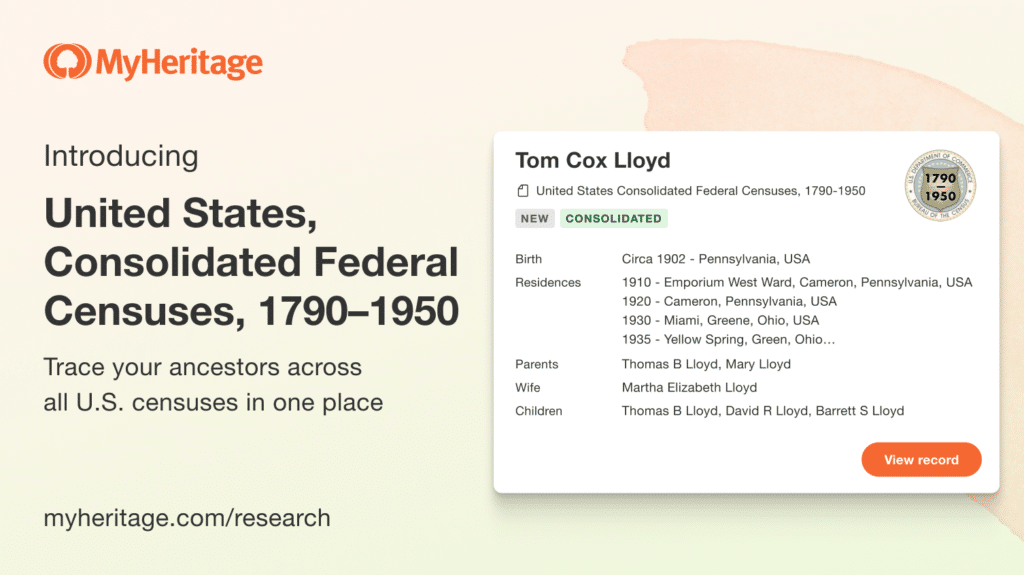
We’re excited to announce the publication of United States Consolidated Federal Censuses, 1790–1950, a new, unique collection on MyHeritage containing 588 million historical records, combined and deduplicated from all 17 U.S. federal censuses. For the first time, users can search the entire span of the U.S. federal census in a single collection, rather than searching each census separately. The new collection is a one-stop shop for all U.S. census research, where each record is richer than any of the individual census records that make it up.
Search billions of historical records
Uncover your family story through historical records

The collection was generated using specialized AI technology developed by MyHeritage to identify individuals appearing in multiple censuses and combine their information into a single consolidated historical record. Thanks to the clever consolidation, the collection includes only 588 million records instead of 841 million that it would have had, if it naively listed every individual census record without deduplication.
The consolidated collection follows your ancestors across decades by bringing information from multiple census appearances together in a single historical record. You can easily explore changes in residences, occupations, and family relationships on one screen without having to find and compare each census entry individually. For the first time, you can trace an individual from childhood to old age, as they were listed in different households – first as a child, and later in life, as a head of household, or a parent of a head of household. This provides a unique perspective that standalone census collections cannot offer.
Search the United States Consolidated Federal Censuses, 1790–1950 collection now
The challenge of tracing ancestors across census records
U.S. federal censuses are among the most valuable resources for family history research in the United States, because they covered the entire population. Conducted every 10 years, they documented individuals and households at different points in time, providing information such as names, ages, residences, occupations, marital status, and family relationships, depending on the census year.
Until now, users looking for an individual across different census years had to search multiple collections. By bringing all 17 U.S. federal censuses together, the new collection provides one convenient place to search across the entire period from 1790 to 1950.
However, identifying the same individual across multiple censuses isn’t always straightforward. Names were often spelled differently, ages were inconsistent, and families moved between cities and states. A person recorded as a child in one census will appear decades later as a married adult living in another state, with little information to connect the two appearances.
MyHeritage has developed AI technology that tackles this challenge by identifying census entries that belong to the same individual across different years and consolidating them into a single historical record, also using clues beyond the census data itself.
Example: One person across 5 U.S. federal censuses
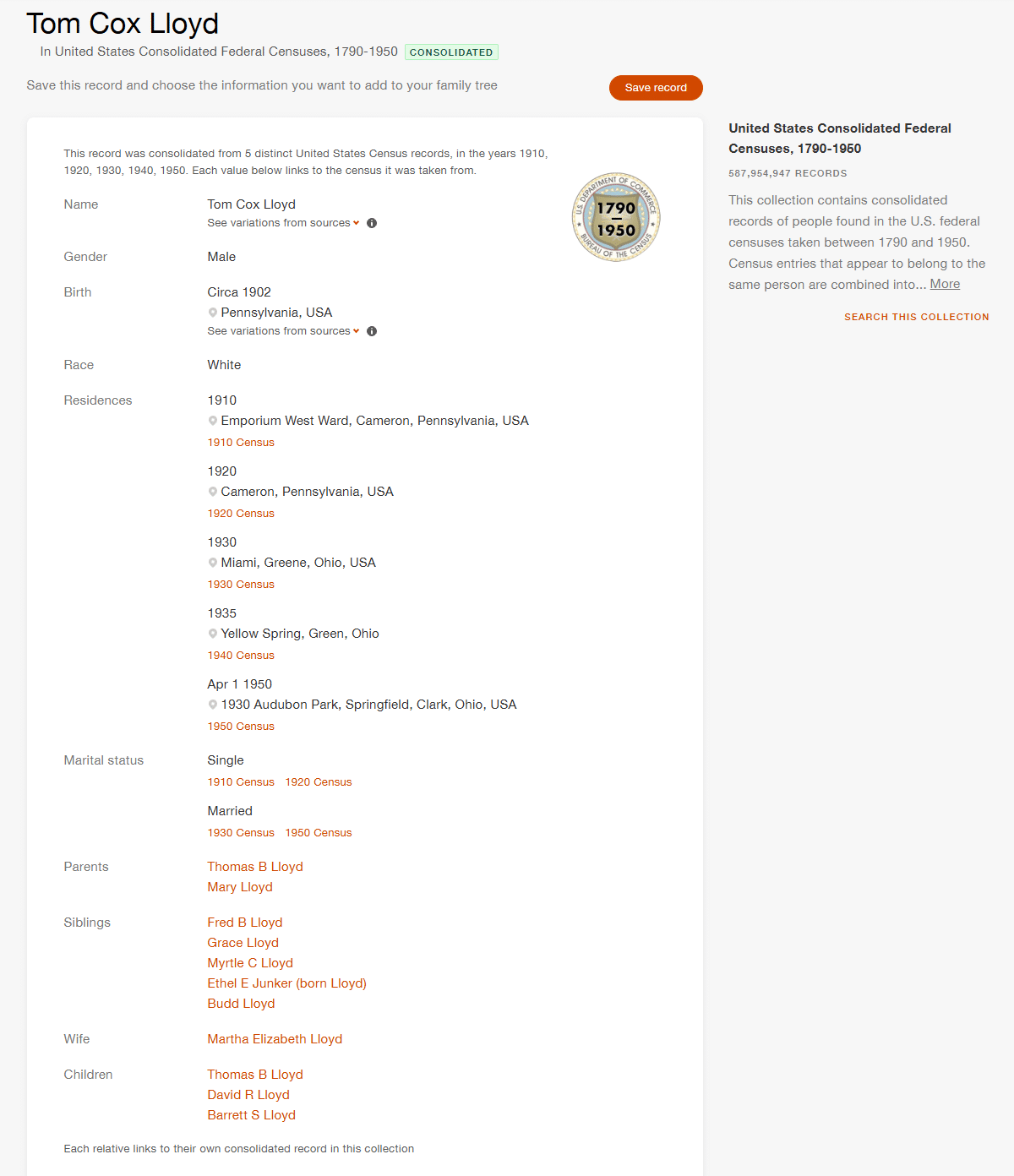
Tom Cox Lloyd’s consolidated record. Click to zoom.
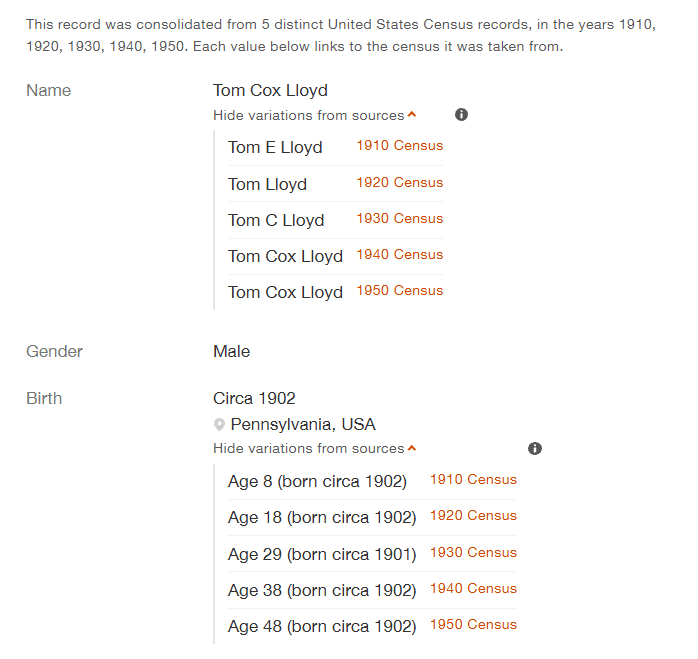
In the example above, the consolidated record of Tom Cox Lloyd brings together 5 U.S. federal census appearances spanning 40 years, from 1910 to 1950. Across these censuses, his name appears as Tom E. Lloyd, Tom Lloyd, Tom C. Lloyd, and Tom Cox Lloyd.
The consolidated record follows him from Pennsylvania to Ohio, showing how his marital status and family changed over time. It also connects him to his parents, 5 siblings, wife, and 3 children, each with links to their own consolidated records. It is very rare to see a census record where an individual is listed with both their parents and their children, but this is exactly the power of MyHeritage’s new consolidated census collection.
A single collection for all U.S. federal censuses
The collection includes historical records from every U.S. federal census conducted between 1790 and 1950. Some records combine information from multiple census appearances, while others contain information from a single census. This means the collection is a complete superset of the census collections, and users can find records of an ancestor even if that person appeared in only one of the censuses.
Where multiple census appearances have been connected, the resulting consolidated record will include an individual’s name, estimated birth year, residences, family members, and relationships, depending on the available census records. Because most censuses recorded ages rather than exact birth dates, estimated birth years may vary between census appearances. Residences are listed by census year, making it easy to follow where an individual lived over time.
Comparing information across census years within a consolidated record is simple and convenient. Click “See variations from sources” to view how names and birth details appeared in the original census records, and follow the links to corresponding census records to examine the original sources and verify the information.
The “Census appearances” section shows the household recorded in each census year, so you can see how it changed over time. This is among the most useful benefits of the new collection.
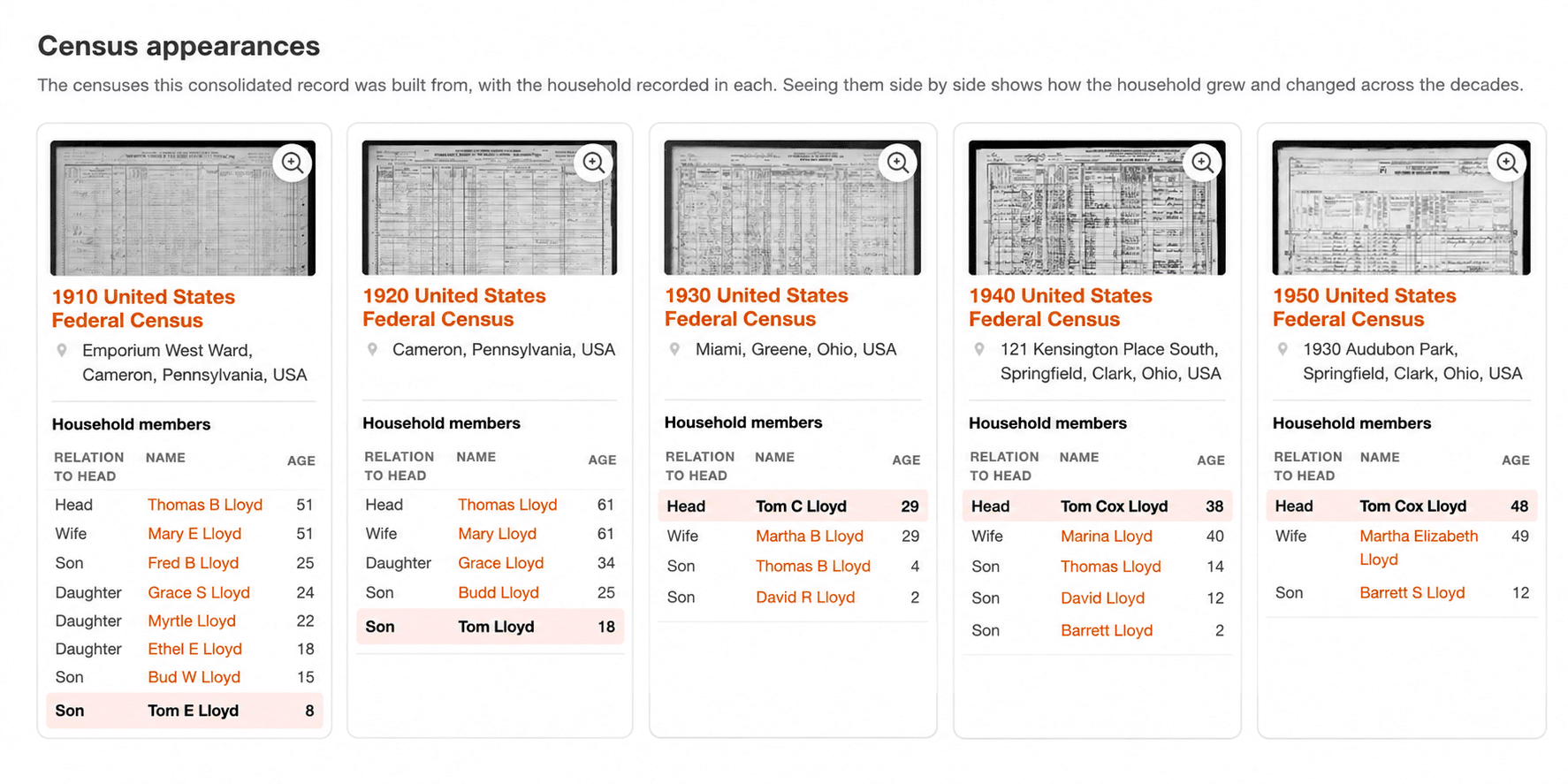
Tom Cox Lloyd across 5 U.S. federal censuses, 1910–1950. Click to zoom.
Examples
Below are a few examples of consolidated census records:
Ernest Hemingway
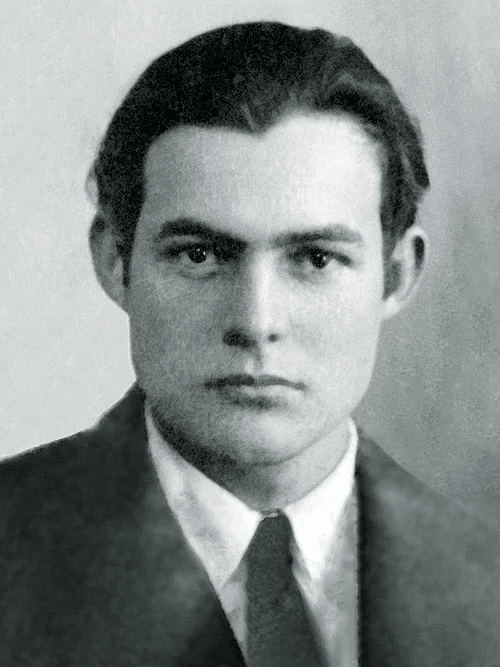
Ernest Hemingway, American author, as a young man.
The consolidated record of renowned American author Ernest Hemingway brings together information from 4 U.S. federal censuses: 1900, 1910, 1920, and 1940.
Connecting these historical records wouldn’t be entirely straightforward when searching the collections manually and separately. His first name appears as Ernest in some censuses and Earnest in others, and his last name appears as either Hemingway or Hemmingway. MyHeritage’s AI technology identified that these spelling variations referred to the same individual and connected the census appearances in a single record.
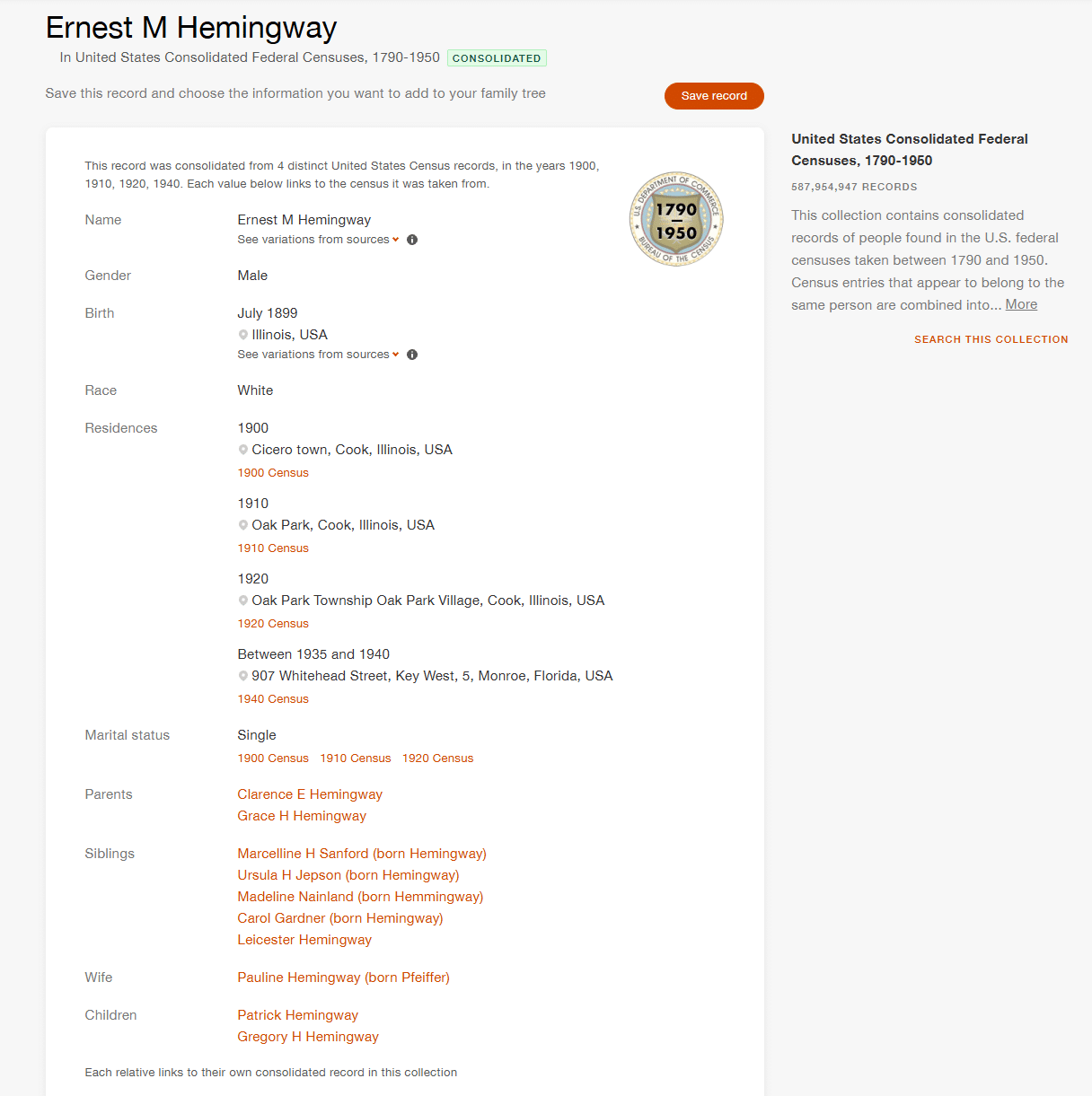
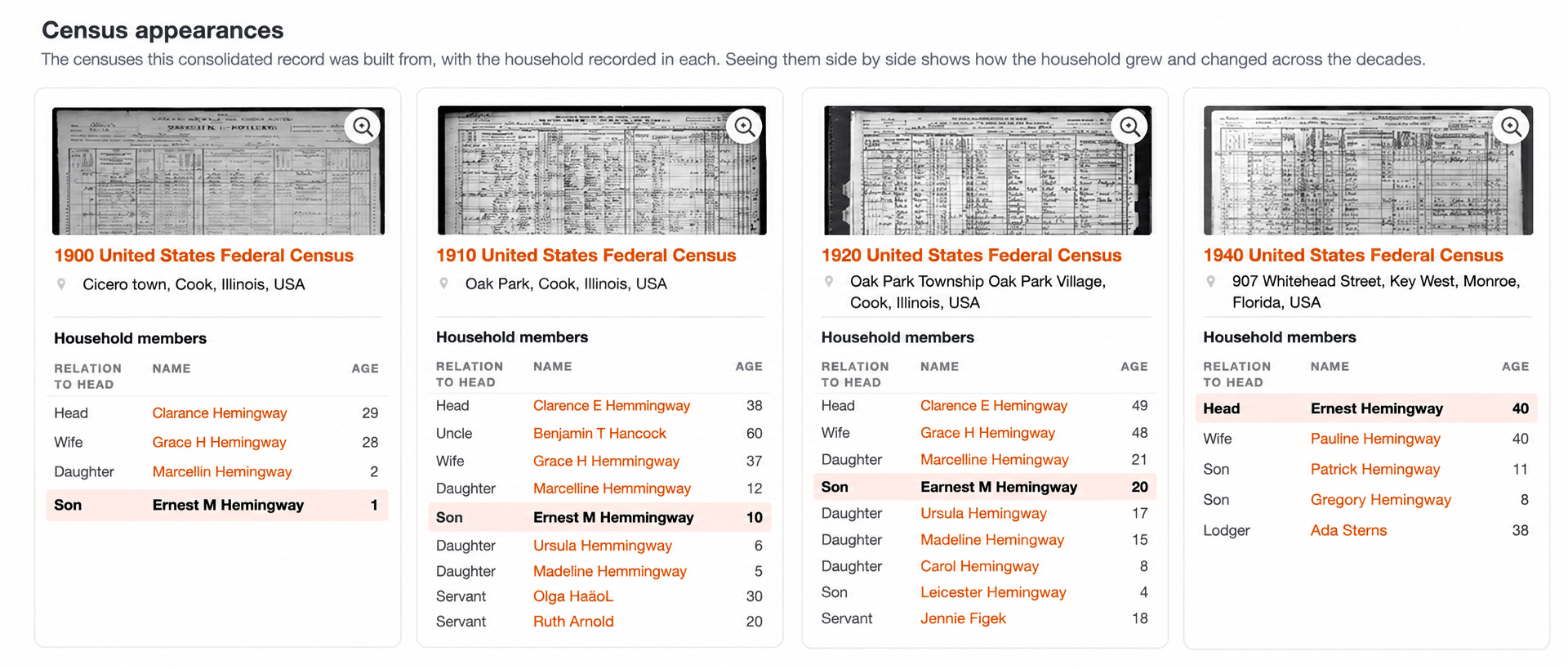
Ernest Hemingway across 4 U.S. federal censuses, 1900–1940. Click to zoom.
The historical records trace Hemingway from his childhood in Illinois to his residence in Key West, Florida, in 1940. They also connect him to his parents, 5 siblings, wife Pauline, and two children. Hemingway is listed as single in the 1900, 1910, and 1920 censuses, as he didn’t marry his first wife, Hadley Richardson, until 1921. He later married Pauline Pfeiffer in 1927, and by 1940, he was recorded as married and living with Pauline and their two sons. His 1930 census appearance is missing from the consolidated record, possibly because he was traveling at the time, although the exact reason is unknown.
Grace Hopper

Grace Hopper, U.S. Navy rear admiral and computer scientist
Grace Hopper, born Grace Murray, was a pioneering American computer scientist and U.S. Navy rear admiral who played a key role in the development of modern computer programming. Her consolidated record brings together her appearances in 4 U.S. federal censuses between 1910 and 1940.
In the 1910 census, Grace appears as a 3-year-old girl living with her parents and sister in Manhattan, New York. The 1920 and 1930 censuses show her continuing to live with her parents and siblings.
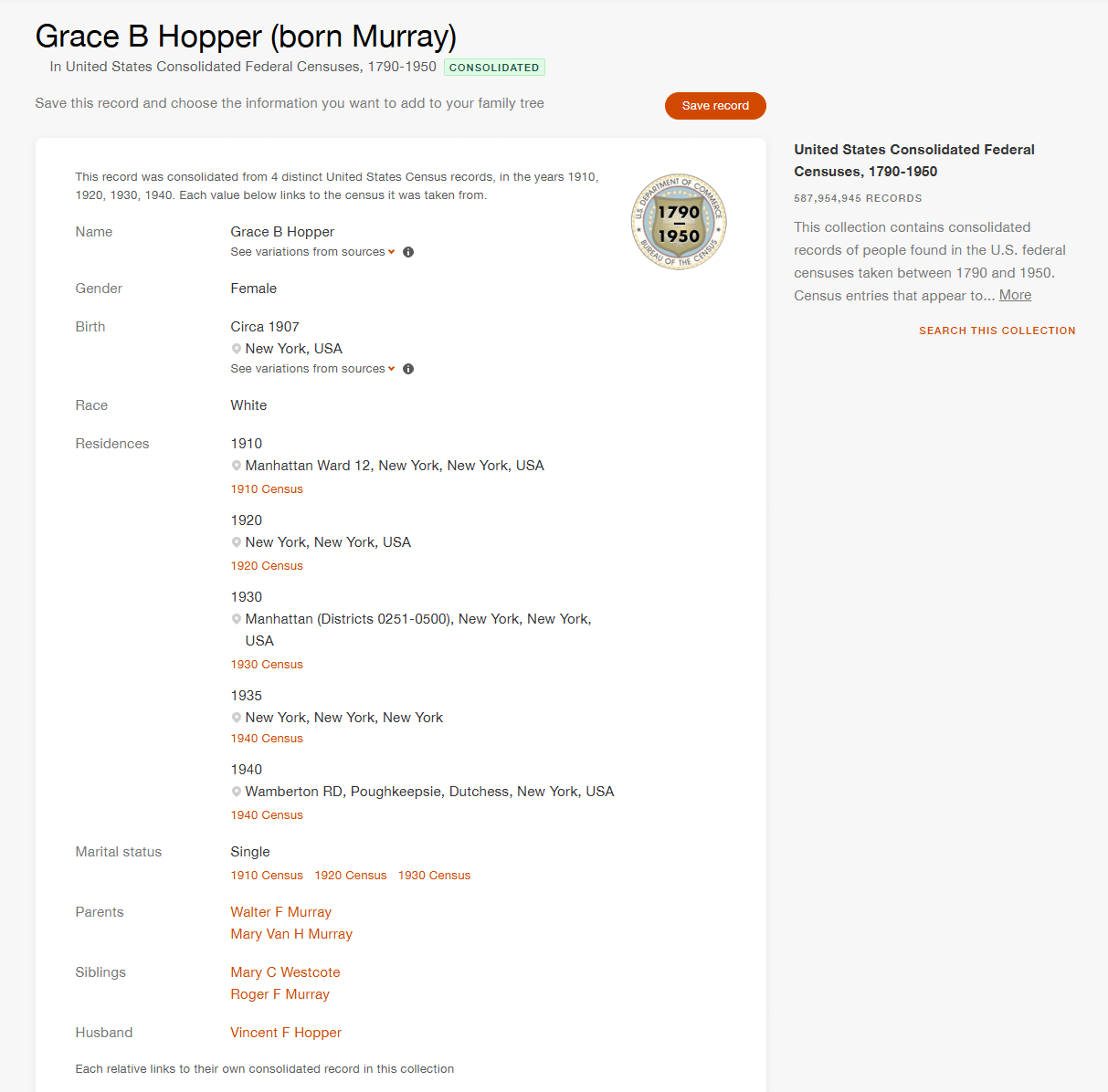
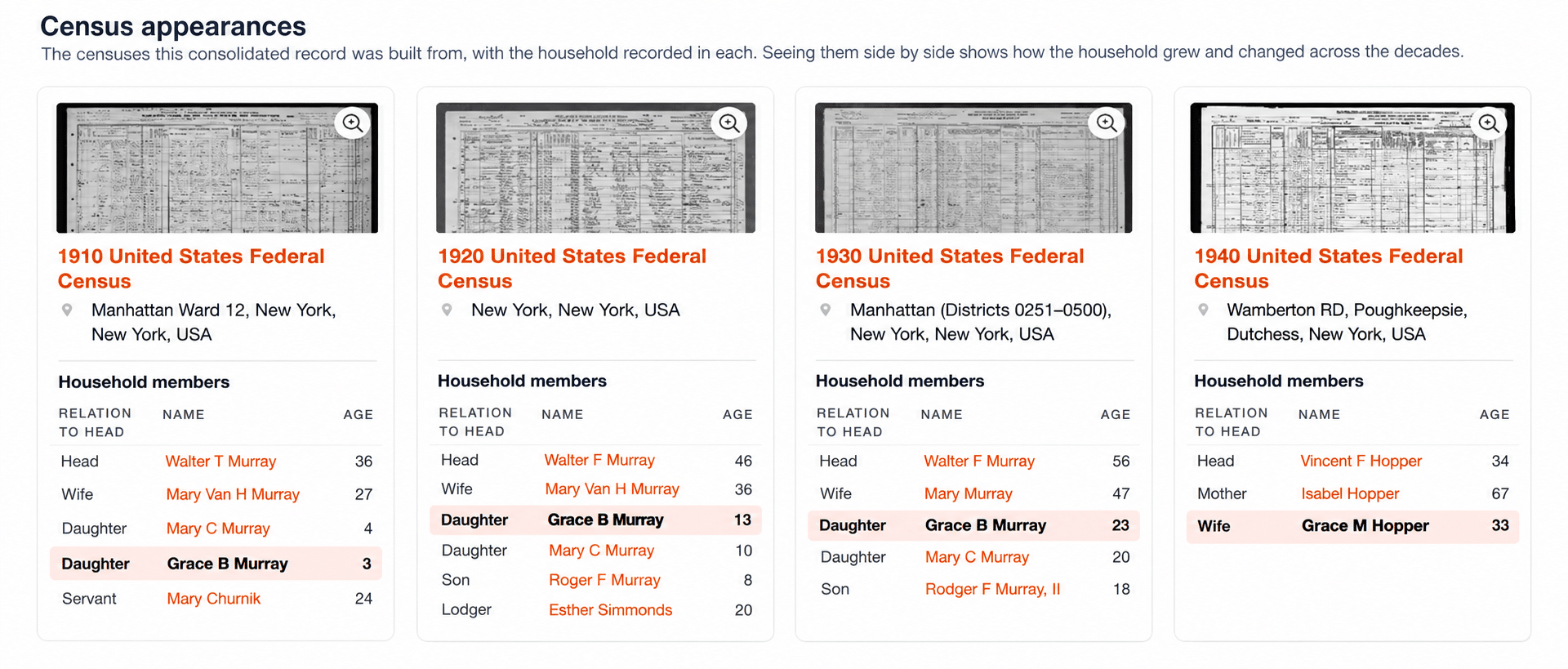
Grace Hopper across 4 U.S. federal censuses, 1910–1940. Click to zoom.
By 1940, her circumstances had changed considerably. She was recorded as Grace Hopper, living in Poughkeepsie, New York, with her husband, Vincent Hopper, and his mother.
Despite the change in surname, residence, and household, MyHeritage’s’s AI technology has connected these 4 census appearances into a single consolidated historical record. The record also provides links to consolidated records for her parents, siblings, and husband.
Record Matches
Users who have a family tree on MyHeritage will soon receive Record Matches with this collection. These matches will be richer and more plentiful than matches on the individual record collections, because the consolidated records are richer in detail and include more relatives, which facilitates better matching.
Pricing
Just like any other collection on MyHeritage, searching this collection is free. To view the full historical records and save them to your family tree, a Data, Complete, or Omni subscription is required.
Summary
The new United States Consolidated Federal Censuses, 1790–1950 collection was built using specialized AI technology developed by MyHeritage that performs the consolidation and deduplication. It saves you time and effort by connecting multiple census appearances and bringing the information they contain into a single convenient record. You can follow your ancestors across decades, trace their moves, and explore changes in their families without having to piece together each census appearance yourself.
Encompassing nearly 588 million historical records from all 17 U.S. federal censuses, including both individual and consolidated records, the collection makes it easier to find your ancestors and explore your family’s past across more than 150 years of U.S. census history.
This collection is another example of how MyHeritage continues to make family history research easier, faster, and more accessible through innovative technology. This collection is just the beginning. We plan to create additional consolidated collections in the future, to unlock more value for genealogists worldwide. Enjoy!
Search the United States Consolidated Federal Censuses, 1790–1950 collection



Comments
No comments yet. Be the first!