
How Many Times Removed? Untangling Distant Family Relationships
What is a first cousin once removed, anyway? How about a second cousin once removed? What does twice removed mean? What is a third cousin? And what do all the “greats” in great-great-aunts or -grandparents mean?
Start your family tree
and make new discoveries

Cousin and relative terminology can get extremely confusing! In this post, we’ll help you understand family relationships once and for all. But we must warn you, it still requires some careful calculation. That’’s why MyHeritage introduced a simplified relationship terminology system that makes it much easier to understand how a given family member is related to you — and we’’ll dive into that later on.
Build your family tree on MyHeritage
First, we’ll provide quick answers to common questions about cousin relationships and a cheat sheet for figuring out cousin relationships. Then, we’ll dive into a deeper explanation.
What do you call your cousin’s kid?
Your first cousin once removed is the child of your first cousin.
What’s a second cousin?
Your second cousin is a person with whom you share a great-grandparent.
What is a second cousin once removed?
A second cousin once removed is either the great-great-grandchild of your great-grandparent, or the great-grandchild of your great-great-grandparent. That is, you are separated by one generation (once removed), and the closest common ancestor you have is a great-grandparent (either the cousin’s or yours).
What is a third cousin?
Your third cousin is a person with whom you share a great-great-grandparent.
What does twice removed mean?
A cousin who is twice removed is two generations removed from you: the grandchild or grandparent of a second, third, fourth, etc. cousin.
What is a great-aunt?
Your great-aunt is your parent’s aunt: the sister or sister-in-law of one of your grandparents.
Cousin relationship cheat sheet
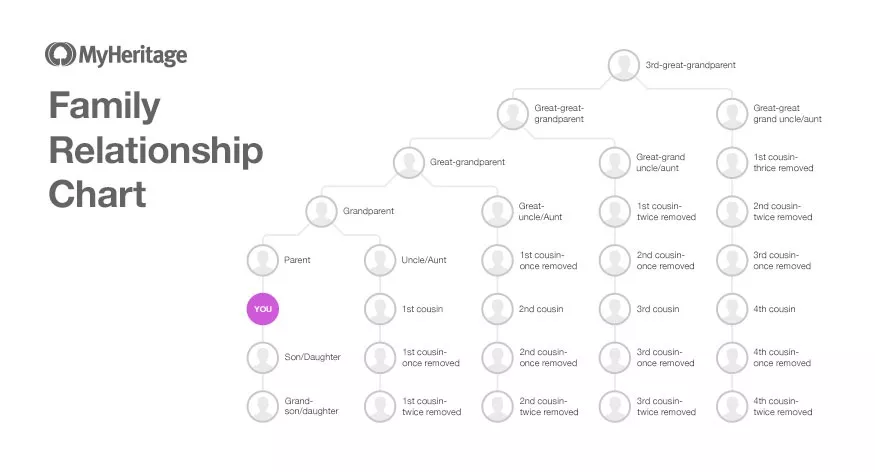
You can download this chart in our “Downloadable resource” section.
Still confused? Let’s back up a bit and look into how this all works:
Great-grandmother? Great-uncle? Intergenerational relationships explained
First, let’s address the question of the “great” prefix, because as you’ll see later on, it’ll help us with the other questions.
The general rule is this: every “grand” or “great” signifies going back one generation.
So for example:
- Grandfather = father’s father
- Great-grandfather = father’s grandfather
- Great-great-grandfather = father’s great-grandfather
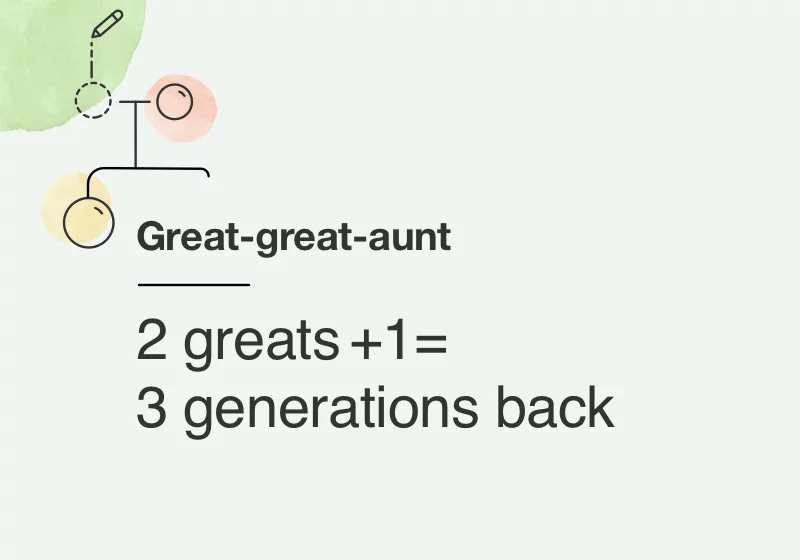
You can figure out how many generations back the ancestor is by counting the “greats” and “grands” and adding 1. For example:

It works the same way with uncles and aunts. There are two standard ways to refer to your grandparents’ siblings: granduncles and grandaunts, or great-uncles and great-aunts. In both cases, the “grand” or the “great” signifies going back a generation.
So for example:
- Aunt = mother’s sister
- Grandaunt or great-aunt = grandmother’s sister
- Great-grandaunt or great-great-aunt = great-grandmother’s sister
According to the rule above — count the “greats” and “grands” and add 1 — your great-great-aunt and your great-grandmother were both from the same generation, which was 3 generations before you:
When saying all those “greats” gets cumbersome, you can shorten it by simply using the ordinal number of “greats”: for example, your great-great-great grandparent is your third-great-grandparent, your great-great-great-great-grandparent is your fourth-great-grandparent, and so on. Some people will say “3-times-great-grandparent” instead.
Now that we’ve got the distances between direct ancestors sorted out, we can wade into the murky waters of cousin relationships.
Cousin number = number of “greats/grands” in the term for your common ancestor
The number of your cousin (first, second, third) is calculated by the shortest distance in generations between either you or your cousin and the ancestor you share.
What does that mean? Let’s start with the simplest examples:
If you share a grandparent, the distance between you is 2 generations, and that makes you first cousins.
If you share a great-grandparent, you are separated by 3 generations, so you are second cousins.
If you share a great-great-grandparent, you are separated by 4 generations, so you are third cousins.
In other words:
[number of generations] – 1 = number of cousin relationship
OR:
Number of “greats/grands” in the term for your common ancestor = number of cousin relationship
Simple enough, right?
The plot thickens
Well, it gets tricky when we start moving up and down generations. Because the ancestor you have in common with, say, your parent’s first cousin would be your great-grandparent, but the cousin’s grandparent. So how many “greats” and “grands” do we count?
That’s where the “shortest distance” factor comes into play. Your parent’s cousin is your first cousin (once removed, as we’ll explain in a minute!), not your second cousin, because even though the ancestor you share is your great-grandparent, that ancestor is your cousin’s grandparent — and that’s the shortest distance in generations between you.
This also works the other way: the child of your first cousin will be your first cousin (once removed), because though the ancestor you share is that child’s great-grandparent, the ancestor was your grandparent. One “grand”=first cousin.
Still confused? Just remember this: your parent’s first, second, and third cousins are your first, second, and third cousins (once removed), and your grandparents’ first, second, and third cousins are your first, second, and third cousins (twice removed).
Okay, so what does the “removed” mean?
“Removed” = distance from *the cousin* in generations
A cousin “zero times removed” is a cousin from the same generation as you. For example, your first cousin is the child of your parent’s sibling. Your parents were part of the same generation, and so are you and your cousin. Your second cousin is the grandchild of your great-uncle or -aunt. Your great-uncle is in the same generation as your grandparents, which means you are in the same generation as his grandchild.
A cousin who is “once removed” is a generation above or below you. For example, your dad’s first cousin, as we mentioned above, is your first cousin, but she is “once removed” because there is a generation between you and her. Another example of a cousin once removed would be the child of your first cousin. Your first cousin is in the same generation as you, so his child would be one generation below you.
A cousin who is “twice removed” will be your cousin’s grandchild or grandparent, or your grandparent’s cousin.
To summarize
Here’s what you need to remember:
- Number of “greats” and “grands” + 1 = number of generations back from you
- Cousin number = number of “greats/grands” in the term for your common ancestor (and if it’s different for you and your cousin — the shortest one)
- Your direct ancestors’ first cousins are your first cousins, their second cousins are your second cousins, etc.
- Times removed = number of generations between you and the cousin
Got it?
No? You’’re not alone. Many people find this system extremely complex and difficult to follow. That’’s why MyHeritage uses simpler relationship terminology.
MyHeritage’’s simplified relationship terms
With the launch of the cM Explainer™ tool in 2023, MyHeritage introduced a simpler and clearer way to describe distant and complex family relationships, both in the cM Explainer™’’s relationship predictions for DNA Matches and within the family tree. Now, for example, instead of “first cousin once removed,” your relative will be described in the family tree as “Your mother’’s cousin,” “Your father’’s cousin,” “Your cousin’’s daughter,” or “Your cousin’’s son.” This both removes the complication of the “cousins removed” system and describes the relationship with greater precision.
You can find your relationship to any person in your family tree right beneath their name in the profile panel:

The double-droplet icon indicates that this cousin is a blood relative, meaning she is related to you by blood and not just by marriage.
Learn more about how to understand and visualize family relationships in the following article: Visualizing Family Relationships with Relationship Diagrams and Color Coding
FAQs about distant family relationships
How can a relationship chart help me figure out tricky cousin connections?
The relationship chart shows you exactly how you’’re connected to various relatives by mapping both of your positions on a shared family tree. You can trace each path visually — moving up to shared ancestors and then back down through generations — to see not only who your relative is but also how many generations apart you are. This makes it easy to understand relationships like “second cousin once removed” or “great-grand uncle” at a glance, without doing mental math or memorizing terminology.
What exactly is a half cousin and how much DNA do we share?
Half cousins occur when the siblings linking two cousin lines are themselves half-siblings who share only one parent. Because the younger generation ends up with just a single shared grandparent, half first cousins share about half the DNA of full cousins of the same degree, typically around six percent rather than the usual twelve.
What makes someone a double first cousin, and why do they look closer in DNA tests?
Double first cousins arise when two siblings from one family marry two siblings from another, giving their children all 4 grandparents in common. That doubling of ancestry boosts the genetic overlap: they trade about twenty-five percent of their DNA, the same ballpark as half-siblings, and can easily fool relationship-prediction tools.
Do “removed” relationships ever include in-law relatives?
The “removed” label measures only the number of generations separating blood cousins. It never applies to in-law connections. Your spouse’s niece is a niece-in-law, not a first cousin once removed, because there is no shared ancestor by blood; without a genetic link the cousin terminology simply does not apply.
Why does MyHeritage label relationships in plain language instead of using “removed”?
MyHeritage swaps jargon for plain English, showing phrases like “Your mother’s cousin” or “Your cousin’s daughter” instead of cryptic tags such as “first cousin once removed.” Many users find these descriptive labels far easier to understand.
Can DNA tests pinpoint whether a match is once or twice removed?
Autosomal DNA services report the number of shared centimorgans and combine that figure with age data to narrow a match to possibilities such as first cousin once removed or second cousin. MyHeritage’s cM Explainer runs exactly this calculation, translating raw DNA overlap into realistic ranges for both the cousin number and any removals.
Comments
No comments yet. Be the first!